Janggi wiki · Board and pieces
Why do Janggi pieces and boards look this way?
Contrasting lettering comes from different ways of writing Chinese characters; the grid and palaces mark playing points and routes. The earliest reason for choosing octagons remains uncertain. Start with an 1895 diagram and surviving boards to explore shapes, sizes, portable materials and digital designs.
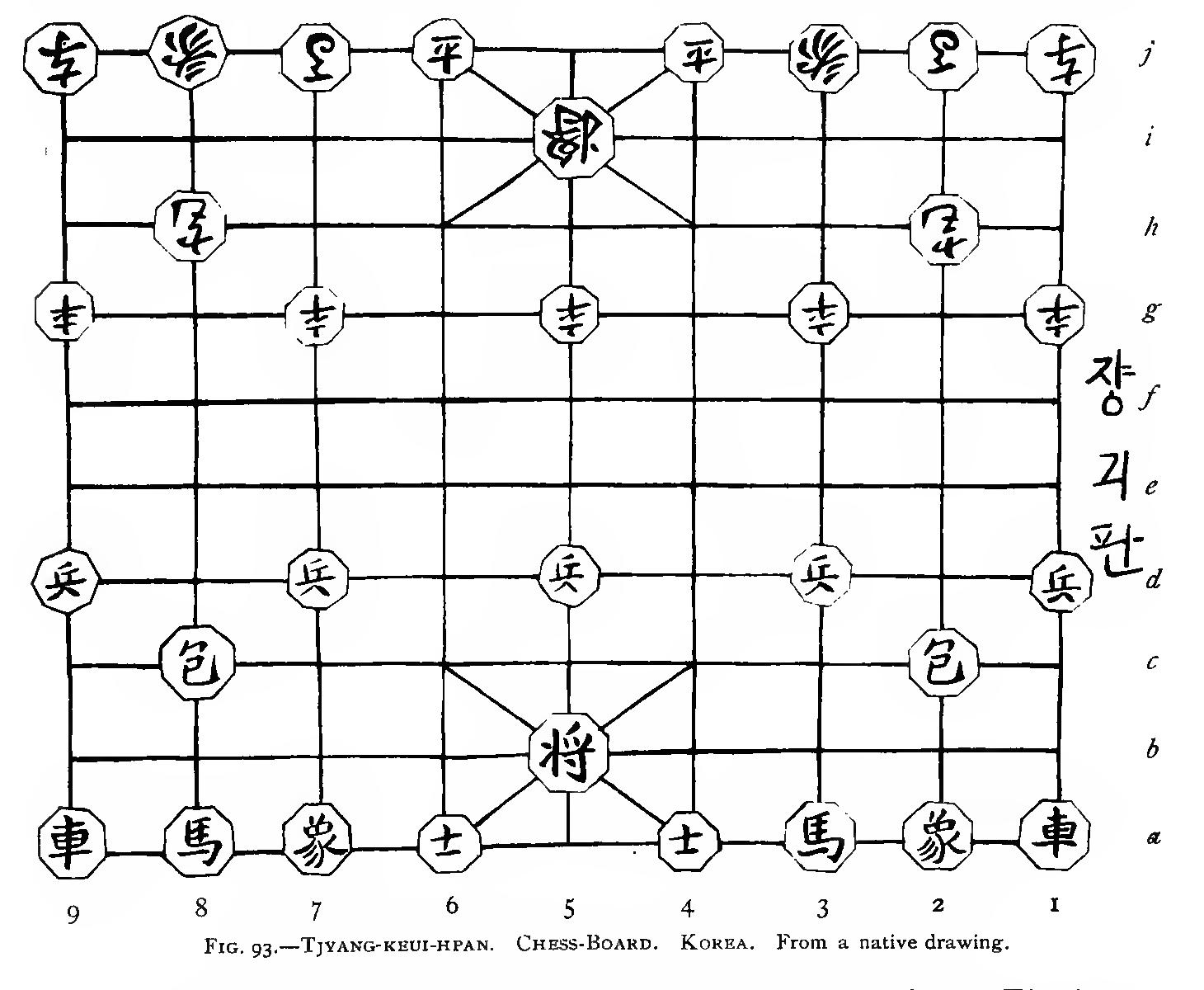
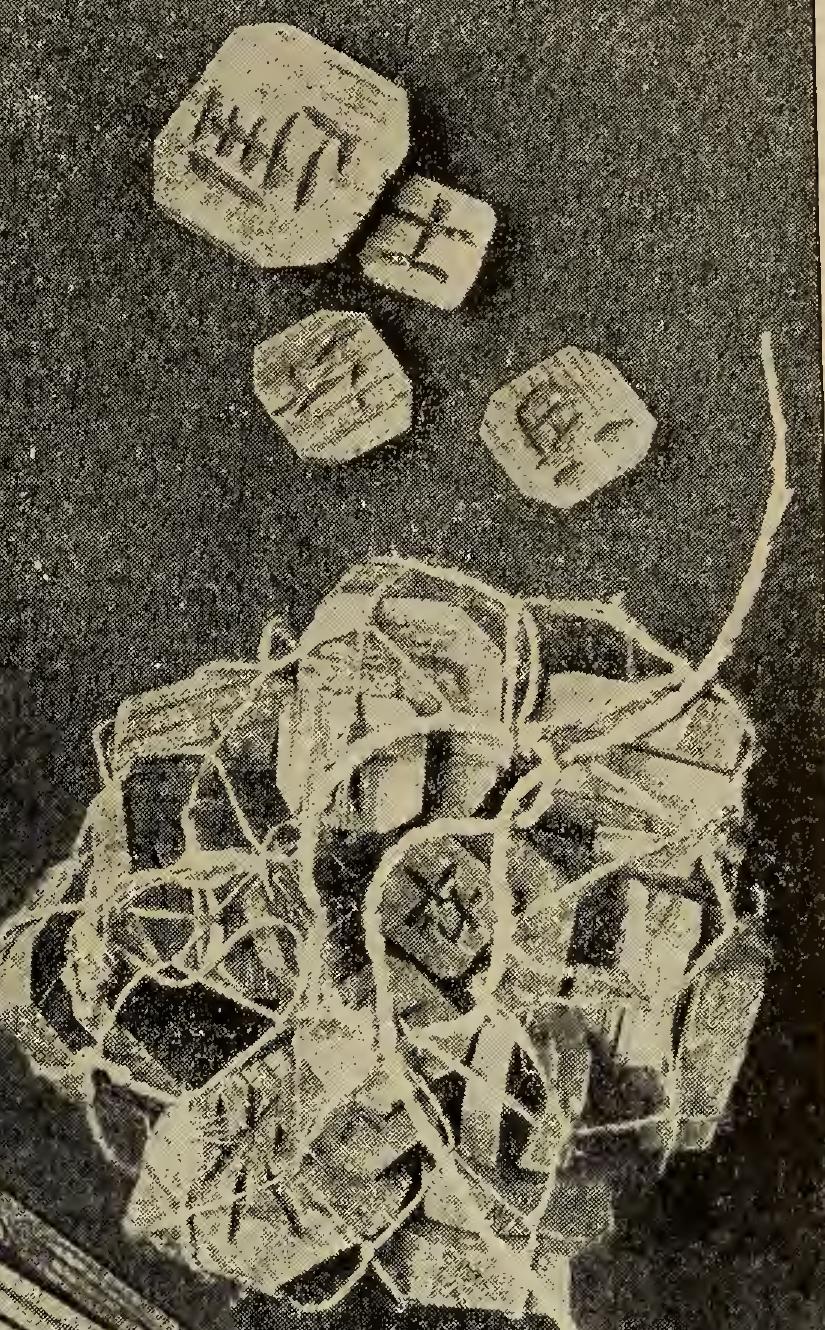
Korean Games (1895), Fig.93, printed p.83, described as based on a Korean drawing. The two sides use different lettering, and 將 marks the royal pieces (generals) rather than today’s familiar 楚 and 漢. Historical evidence, not a modern setup guide. Edited by Stewart Culin; chapter by W. H. Wilkinson. Cornell / Internet Archive scan, Public Domain Mark 1.0. Figure excerpted without redrawing. View source
Some Janggi characters are written distinctly; others look like flowing curves. The cut-corner pieces and the board’s two X-shaped marks combine calligraphy, side identification and movement rules. Records and actual objects show what continues into modern equipment and what varied even in the past.
Start with a board recorded in 1895
The diagram is both familiar and different. Pieces stand on intersections, and diagonals cross at each end. The lower 車 (chariot) and 馬 (horse) are comparatively easy to recognize; the lettering for the same roles above is more flowing. These contrasts in lettering and outline already appear together in a late nineteenth-century source.[1]
The chapter accompanying the drawing records cursive lettering on one side and describes the pieces’ outlines and sizes. It provides a starting point based on what was recorded at that time, rather than an assumption that the equipment always looked exactly like modern sets.[1]
Different lettering can name the same piece
A character’s identity and the way it is written are different things. 車 names the chariot, called cha in Korean, and 馬 the horse, called ma. A writer can show their strokes distinctly or simplify and join them.[5][6]
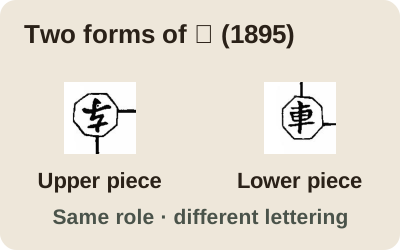
Regular script, called haeseo (楷書) in Korean, makes the strokes and structure comparatively distinct. Cursive script, choseo (草書), simplifies or connects them according to established calligraphic conventions. The original character may be hard for a beginner to recognize. 草 in the name of the script and 楚 in Cho, the name of a Janggi side, are different characters. Unfamiliar Cho lettering is not evidence of a separate alphabet or a script unique to the ancient state of Chu.[5][6]
Modern descriptions of traditional-style sets associate red regular script with Han and blue-toned cursive lettering with Cho, the two opposing sides. Individual products and digital themes can vary. Learn each piece’s name and movement first, then connect its flowing form with that name.[7]
The 1895 account also describes flowing lettering on one side, with the characters colored red and green. Today’s blue tones need not be projected onto every period. Color and script together provide cues for distinguishing the sides. This is an explanation of their present-day function; the record does not identify who first chose that combination.[1]
Octagons are familiar, but round pieces existed too
An octagon resembles a square with its four corners cut off. It is a recognizable outline of traditional-style Janggi pieces, but the sources reviewed here do not establish why eight sides were first chosen.[1]
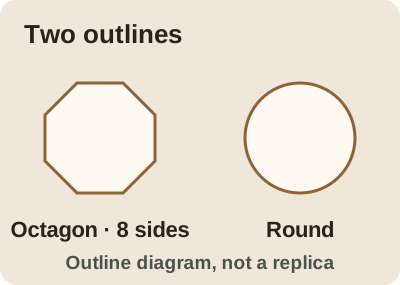
The 1895 book describes octagonal pieces. A footnote on the same page, however, says the set exhibited by the Korean government at the 1893 Columbian Exposition in Chicago had round pieces. The equipment was therefore not described as having only one outline at that time. The footnote also challenges the assumption that round pieces must be a recent departure.[1]
Manufacturing and the feel of a piece in the hand are questions worth investigating. Ease of making or gripping an outline cannot simply be substituted for a documented historical origin. The sources reviewed here do not establish explanations based on eight directions or the eight trigrams.[1]
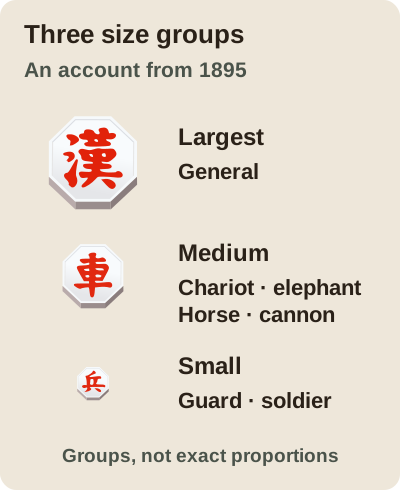
The outline is not the only feature. The same book describes three size groups: the general, Janggi’s royal piece called gung in Korean, is largest; chariots, elephants, horses and cannons are medium; guards and soldiers are smallest. Cho’s soldier is called jol and Han’s byeong. Color, script and size all appear on one object. The general being largest shows that size is not simply a ranking by material points.[1]
The lines show where pieces can stand and travel
A board is easier to count once the squares and intersections are distinguished. Pieces stand on the intersections, not inside the squares. Nine vertical and ten horizontal lines provide 90 points. The spaces between the lines form eight columns and nine rows, or 72 small squares. The totals differ because they count different things.[8]
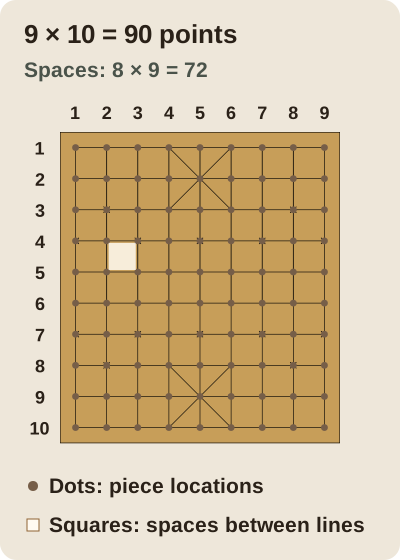
If horizontal and vertical spacing are equal, the grid area is a rectangle with an 8:9 width-to-height ratio. That follows from the number of intervals. Actual objects can vary their line spacing and border width, so this ratio is not a fixed specification for the entire physical board.[8]
The X at each end is functional. Each palace, the area in which a general and its guards remain, contains three columns and three rows of intersections, with diagonals connecting certain points. The general and guards move one step along a drawn line within their own palace. Chariots and cannons may also use palace diagonals under their own movement restrictions. The marks and the rules work together.[9]
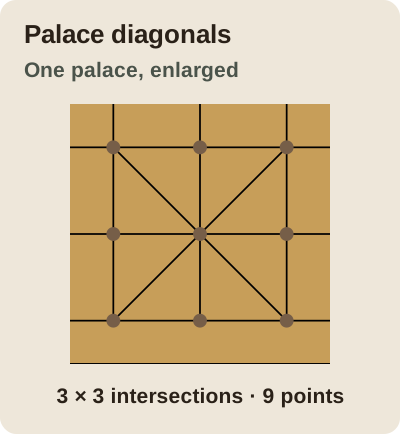
These are ways of reading a board today. Why the earliest board used 9×10 is a separate historical question. Understanding a current function does not establish the first designer’s intention. The sources here do not identify numerical symbolism or a single inventor as the confirmed origin of the grid.[1]
Outer proportions need not be treated as universal either. The writer of the 1895 chapter observed that the boards he described were wider in one direction and interpreted this as making the opponent’s end easier to reach. That is his explanation, not proof that all boards had the same proportions or were originally designed for that reason. Borders, legs and storage spaces can make the same grid into very different objects.[1]
From a board with a drawer to portable designs
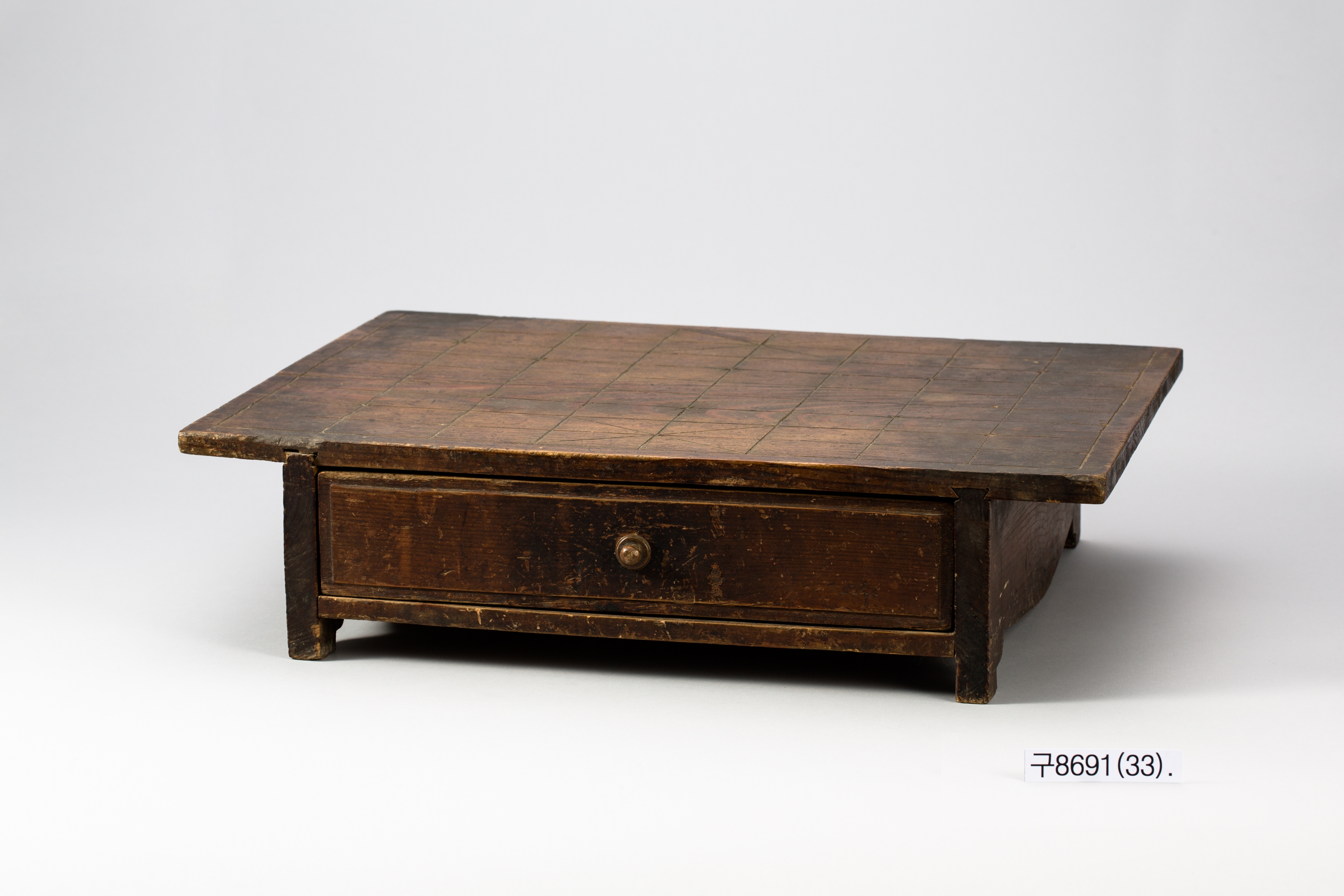
The Joseon wooden board resembles a small piece of furniture. Legs support its top, and a drawer appears at the front. Storage is part of the same physical object. The photograph alone cannot tell us what was always kept inside. Joseon was a Korean dynasty; the museum’s period classification does not give this board an exact manufacture date.[3]
Another museum board, Sinsu 9585, is classified as pine wood from the Japanese colonial period in Korea. Such surviving objects provide concrete evidence for period and material. A wooden museum board does not represent every setting in which people played.[4]
Walter Hough’s report on Korean collections in the US National Museum records pine chessmen collected in Seoul in 1885 and says the game is played on a board of wood or paper. Paper boards therefore appear in a late nineteenth-century account as well. The evidence does not support an image of all early games requiring heavy wooden furniture.[2]
A Korean utility-model specification published in 2009 addresses portability. It describes existing wooden boards and designs involving plastic, iron plates and magnetic pieces, then proposes a cloth board that can be folded or rolled into a pouch. This documents a design proposal and its stated background at that time. It does not establish that cloth boards were first invented then or became the dominant product.[10]
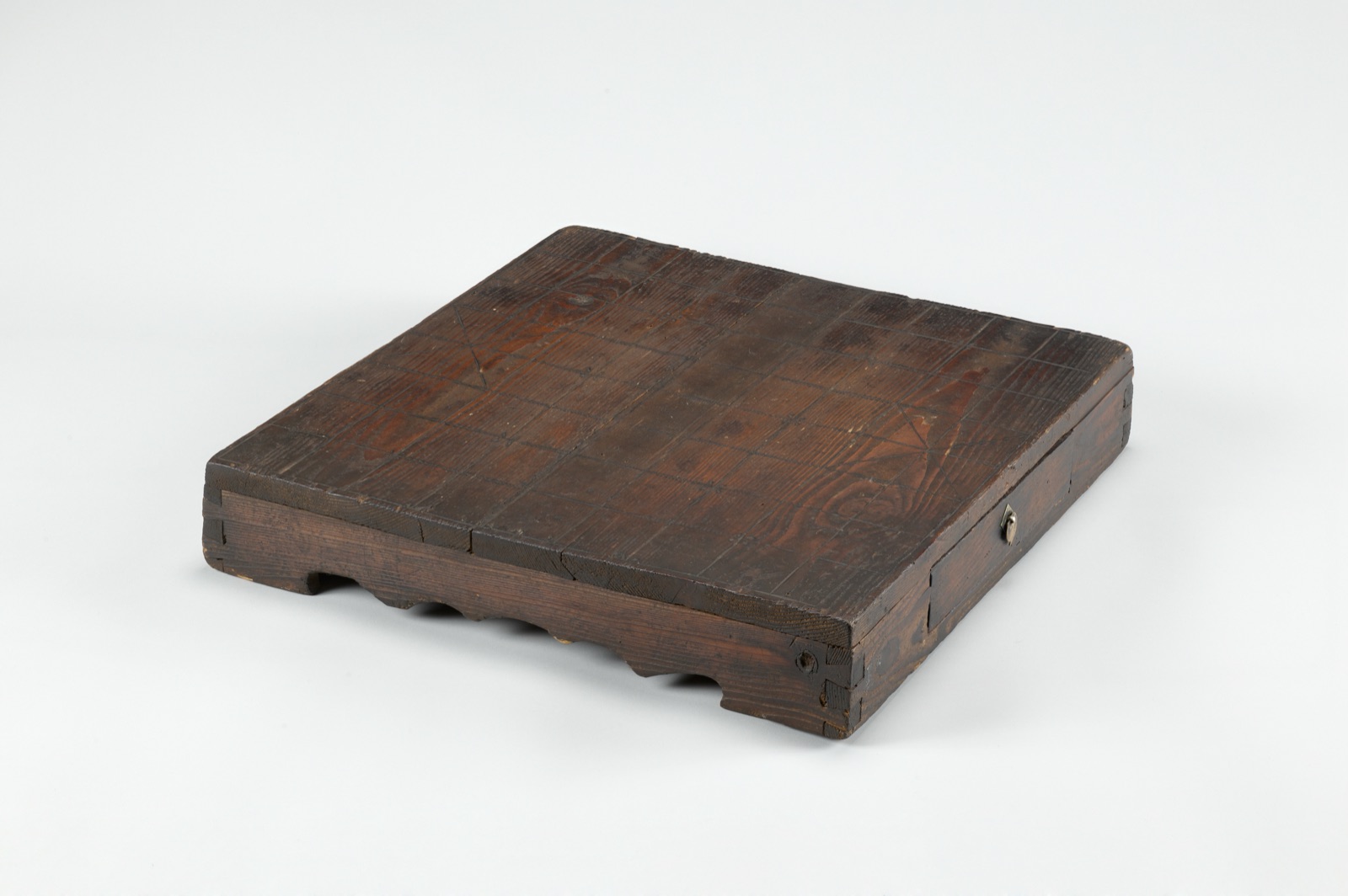
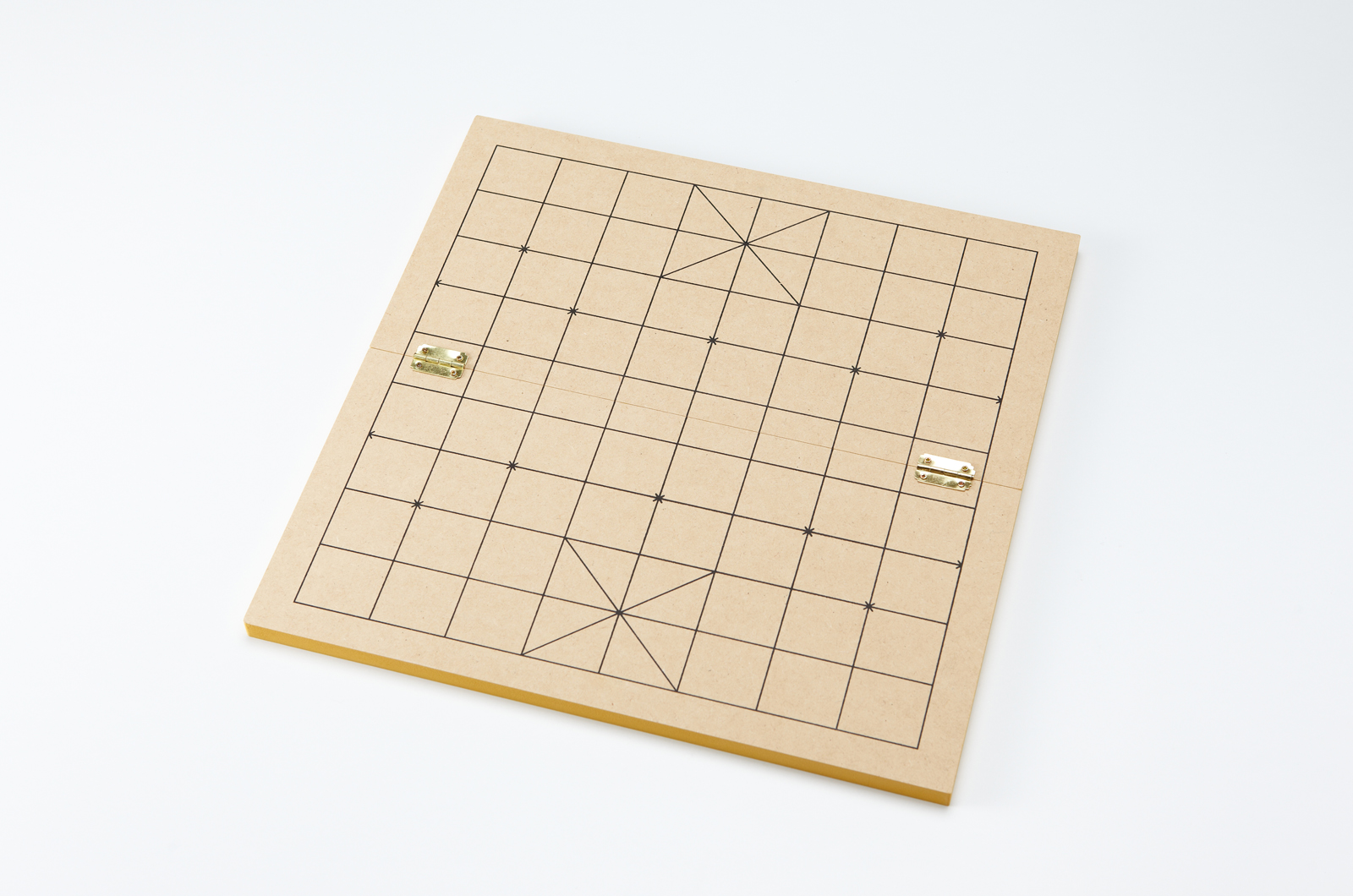
A modern photograph also lets us compare storage arrangements. Metal hinges connect the two parts of the board shown below. Instead of the earlier board’s drawer, this example incorporates a folding connection in the playing surface. The photograph does not establish its wood species or exact board composition.[13][14]
Current sales descriptions include both wooden pieces and plastic octagonal pieces. A new material need not immediately displace an older one. Where a board will be used, how it is stored, and the feel a player prefers can support different choices. That last point is an interpretation of use, not a measurement of market share.[11][12]
Cues that survive on a screen
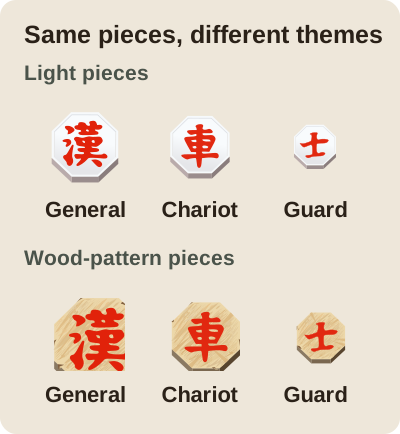
Digital Janggi pieces are images rendered on a screen. A wood-pattern theme represents a material visually; it is not physical wood. Without the feel of a piece in the hand, lettering, color and outline remain recognition cues. Physical and digital pieces differ in material, but reading names, distinguishing sides and locating pieces on intersections continue.[16]
Returning to the 1895 diagram, the features can now be distinguished: flowing lettering is a script, octagons are one recorded outline, and palace diagonals mark usable connections. Legs and a drawer make a grid into a practical object. Understanding the design begins with reading these different features and keeping the evidence for each in view.[1][3]
References
- Stewart Culin · Korean Games (1895)W. H. Wilkinson’s chapter, pp.82–84 and Fig.93: lettering, three sizes, octagonal pieces and a footnote about round pieces; also a reproduction of Kim Jun-geun’s painting. Public domain. · Source checked: 2026-10-06
- Walter Hough · Korean collections in the US National Museum (1893)Printed p.478 and Plate XXIV in the 1893 publication drawn from the 1891 report. Pine pieces and wood/paper boards; conflicting shape descriptions remain unresolved. Public-domain scan. · Source checked: 2026-10-06
- National Museum of Korea · Janggi board, Gu 8691Wooden board classified as Joseon; dimensions and museum photograph. Exact year and species unspecified. Korea Open Government License Type 1. · Source checked: 2026-10-06
- National Museum of Korea · Janggi board (Sinsu 9585)Pine board from the Japanese colonial period; Korea Open Government License, Type 1. Korean source. · Source checked: 2026-09-22
- National Institute of Korean History · Introduction to Korean manuscriptsDefinitions of regular, running and cursive script. Korean source. · Source checked: 2026-10-06
- Encyclopedia of Korean Culture · Cursive scriptDefinition of simplified, flowing calligraphy; does not establish when Janggi assigned scripts to its sides. Korean source. · Source checked: 2026-10-06
- Hangame Janggi · Piece appearanceSupplementary account of modern traditional colors and scripts. Explanations based on national character or symbolism are not adopted. Korean source. · Source checked: 2026-10-06
- Korean Janggi Federation · Introduction to JanggiBoard, pieces, and an overview of play. Korean source. · Source checked: 2026-09-22
- Korean Janggi Association (대한장기협회) · Piece movementOfficial movement paths and blocking conditions. Korean source. · Source checked: 2026-09-23
- An Myeong-hwa · Cloth-board utility model KR20090001472UFiled 9 August 2007; published 12 February 2009. Korean specification describes prior designs and proposes a portable cloth board. Not evidence of first invention or market adoption. · Source checked: 2026-10-06
- Six Brothers Baduk · Wooden Janggi piecesCurrent wooden-product listing only, not verified species, manufacturing process or market share. Product photographs are not reused. · Source checked: 2026-10-06
- 11st · Plastic octagonal Janggi piecesCurrent retailer description only, not chemical verification or evidence of first historical use. Product photographs are not reused. · Source checked: 2026-10-06
- National Institute of Korean Language · Board photographSource image with a fold line and hinges, posted 23 May 2012. Posting date is not manufacture date. Attribution and share-alike terms apply. · Source checked: 2026-10-06
- National Institute of Korean Language · Commons photo mirror1600×1060 photograph; CC BY-SA 2.0 KR. Exif date 23 October 2011 is distinct from object manufacture. · Source checked: 2026-10-06
- Creative Commons · Public Domain Mark 1.0Rights description for the 1895 illustration. · Source checked: 2026-09-22
- Kadagaden · Janggi piece SVGsOriginal piece artwork. Small-screen vectors are modified to remove blur filters. CC BY 4.0. · Source checked: 2026-09-22
- Creative Commons · Attribution 4.0 InternationalReuse and attribution terms for the piece artwork. · Source checked: 2026-09-22
- Creative Commons · Attribution-ShareAlike 2.0 KoreaReuse terms for the National Institute of Korean Language photograph. · Source checked: 2026-10-06